Skip to article frontmatterSkip to article content
Site not loading correctly?

This may be due to an incorrect BASE_URL configuration. See the MyST Documentation for reference.

Basic principles

This first chapter presents the basic principles used to produce the system of equations to be solved.

1Principle of minimum potential energy

The total potential energy VV can be decomposed into elastic energy UU, and the work due to external forces WextW_{ext}:

V=UWextV = U - W_{ext} \nonumber

This potential becomes stationary when:

δV=δUδWext=0\delta V = \delta U - \delta W_{ext} = 0 \nonumber

1.1Strain Energy

The general expression for the strain energy when σ\boldsymbol{\sigma} increases linearly with epsilon\boldsymbol{epsilon} is:

U=12ΩσεdΩU = \frac{1}{2} \int_{\Omega} \boldsymbol{\sigma}^\top \boldsymbol{\varepsilon} \, d\Omega \nonumber

The variation of this expression, valid also for the case of σ\boldsymbol{\sigma} being a non-linear function of ε\boldsymbol{\varepsilon}, renders:

δU=ΩσδεdΩ\delta U = \int_{\Omega} \boldsymbol{\sigma}^\top \delta \boldsymbol{\varepsilon} \, d\Omega \nonumber

To calculate the strain energy in semi-analytical formulations of plates and shells, it is convenient to represent the second-order tensors of strain and stress are represented as vectors, according to Voigt’s notation Voigt, 1910.

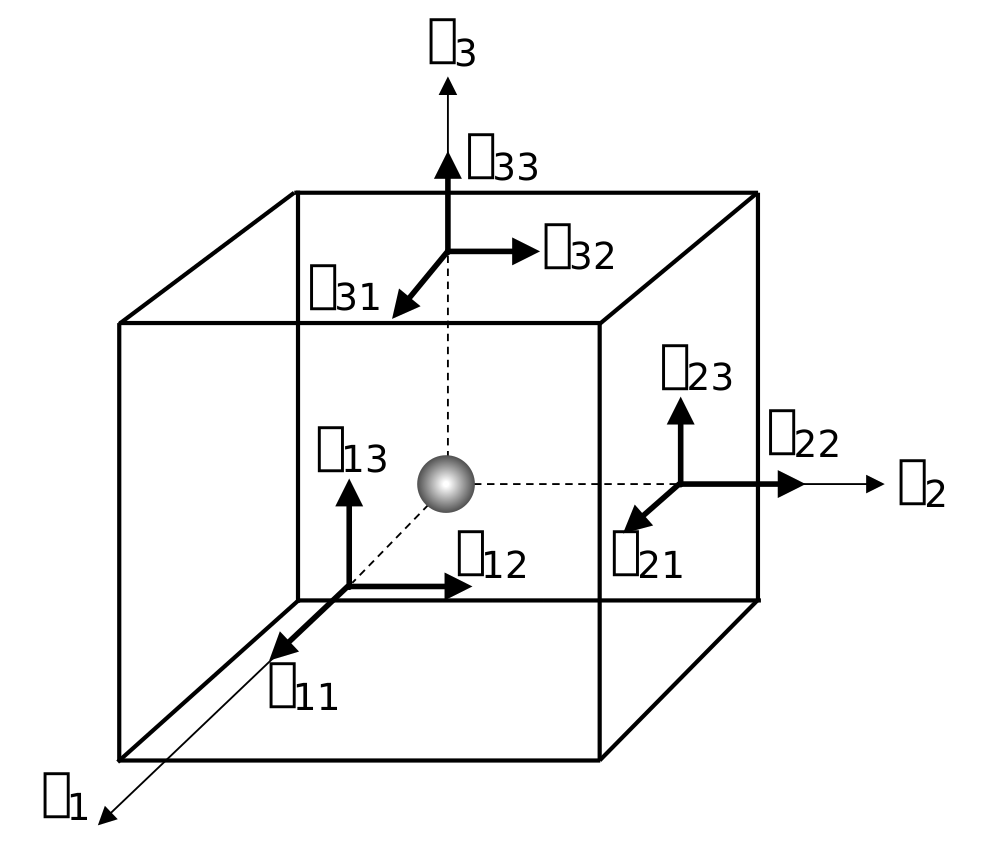
Complete stress state of a material point.

Figure 1:Complete stress state of a material point.

Given the 3D stress state of a material point illustrated in Figure 1, the components of the stress tensor σij\sigma_{ij} can be aligned in a vector as in Eq. (1).

σ={σ11σ22σ33σ23σ13σ12}\boldsymbol{\sigma} = \left\{ \begin{matrix} \sigma_{11}\\ \sigma_{22}\\ \sigma_{33}\\ \sigma_{23}\\ \sigma_{13}\\ \sigma_{12} \end{matrix} \right\}

where:

A general constitutive relation for semi-analytical models, which show stresses relate to strains, can be written based on Voigt’s notation:

σ=Cε\boldsymbol{\sigma} = \boldsymbol{C}\boldsymbol{\varepsilon}

where C\boldsymbol{C} is the constitutive matrix.

Not all stress components shown in Eq. are relevant when calculating thin-walled structures. For plane stress using the Classical Laminated Plate Theory (CLPT):

εxx,εyy,γxy,σxx,σyy,τxy\varepsilon_{xx}, \varepsilon_{yy}, \gamma_{xy}, \sigma_{xx}, \sigma_{yy}, \tau_{xy} \nonumber
ε={εxxεyyγxy}σ={σxxσyyτxy}\boldsymbol{\varepsilon}^\top = \{ \varepsilon_{xx} \quad \varepsilon_{yy} \quad \gamma_{xy} \} \qquad \boldsymbol{\sigma}^\top = \{ \sigma_{xx} \quad \sigma_{yy} \quad \tau_{xy} \} \nonumber

For plane stress using the First- or Third-order Shear Deformation Theory (FSDT or TSDT):

εxx,εyy,γxy,γyz,γxz\varepsilon_{xx}, \varepsilon_{yy}, \gamma_{xy}, \gamma_{yz}, \gamma_{xz} \nonumber
σxx,σyy,τxy,τyz,τxz\sigma_{xx}, \sigma_{yy}, \tau_{xy}, \tau_{yz}, \tau_{xz} \nonumber
ε={εxxεyyγxyγyzγxz}σ={σxxσyyτxyτyzτxz}\boldsymbol{\varepsilon}^\top = \{ \varepsilon_{xx} \quad \varepsilon_{yy} \quad \gamma_{xy} \quad \gamma_{yz} \quad \gamma_{xz} \} \qquad \boldsymbol{\sigma}^\top = \{ \sigma_{xx} \quad \sigma_{yy} \quad \tau_{xy} \quad \tau_{yz} \quad \tau_{xz} \} \nonumber

The strains are usually expressed in terms of displacements in the so called kinematic equations, which can be generally written using Voigt’s notation as:

ε=Bu\boldsymbol{\varepsilon} = \boldsymbol{B}\boldsymbol{u} \nonumber

where B\boldsymbol{B} \equiv differentiation operator matrix, u(x,y,z)\boldsymbol{u}(x,y,z) \equiv continuous displacement field.

1.1.1Finite elements

In finite elemets, interpolation functions are used to approximate the displacement field within each finite element, which can be generally written as:

u={u(x,y,z)v(x,y,z)w(x,y,z)}=S(x,y,z)uˉ\boldsymbol{u} = \begin{Bmatrix} u(x,y,z) \\ v(x,y,z) \\ w(x,y,z) \end{Bmatrix} = \boldsymbol{S}(x,y,z) \, \boldsymbol{\bar{u}} \nonumber

where uˉ\boldsymbol{\bar{u}} \equiv nodal displacements and S(x,y,z)\boldsymbol{S}(x,y,z) \equiv interpolation (shape) functions valid only within the domain of one finite element.

Example for quadrilateral elements:

u=S1uˉ1+S2uˉ2+S3uˉ3+S4uˉ4\boldsymbol{u} = \boldsymbol{S}_1 \boldsymbol{\bar{u}}_1 + \boldsymbol{S}_2 \boldsymbol{\bar{u}}_2 + \boldsymbol{S}_3 \boldsymbol{\bar{u}}_3 + \boldsymbol{S}_4 \boldsymbol{\bar{u}}_4 \nonumber

From the kinematic equations: ε=Bu\boldsymbol{\varepsilon} = \boldsymbol{B}\boldsymbol{u}, the differentiation operator B\boldsymbol{B} will contain the proper derivatives of the interpolation functions corresponding to a given finite element.

The stress strain relation σ=Cε\boldsymbol{\sigma} = \boldsymbol{C}\boldsymbol{\varepsilon} will highly depend on each case. For trusses and beam (uniaxial stress), it can be simply σxx=Eεxx\sigma_{xx} = E\varepsilon_{xx}, for plates this becomes more complicated, as covered later.

In finite elements, the strain energy can be thus expressed as:

δU=ΩσδεdΩ\delta U = \int_{\Omega} \boldsymbol{\sigma}^\top \delta \boldsymbol{\varepsilon} \, d\Omega \nonumber

Replacing σ=Cε\boldsymbol{\sigma} = \boldsymbol{C}\boldsymbol{\varepsilon}, for C=C\boldsymbol{C} = \boldsymbol{C}^\top:

δU=ΩεCδεdΩ\delta U = \int_{\Omega} \boldsymbol{\varepsilon}^\top \boldsymbol{C} \, \delta \boldsymbol{\varepsilon} \, d\Omega \nonumber

Replacing and ε=Buˉ\boldsymbol{\varepsilon} = \boldsymbol{B}\boldsymbol{\bar{u}}:

δU=uˉΩBCBdΩδuˉ\delta U = \boldsymbol{\bar{u}}^\top \int_{\Omega} \boldsymbol{B}^\top \boldsymbol{C} \, \boldsymbol{B} \, d\Omega \, \delta \boldsymbol{\bar{u}} \nonumber
δU=uˉKδuˉ\delta U = \boldsymbol{\bar{u}}^\top \boldsymbol{K} \, \delta \boldsymbol{\bar{u}} \nonumber

where K\boldsymbol{K} is the constitutive stiffness matrix, usually referred to as simply the stiffness matrix:

K=ΩBCBdΩ\boldsymbol{K} = \int_{\Omega} \boldsymbol{B}^\top \boldsymbol{C} \, \boldsymbol{B} \, d\Omega \nonumber

For finite elements, the rows and columns of K\boldsymbol{K} correspond to the degrees-of-freedom built by the assembly of all finite elements. The integration over the 3-dimensional domain Ω\Omega is performed in a piece-wise manner within the domain of each finite element Ωe\Omega_e.

K=e=1neKe\boldsymbol{K} = \sum_{e=1}^{n_e} \boldsymbol{K}_e \nonumber
Ke=ΩeBCeBdΩe\boldsymbol{K}_e = \int_{\Omega_e} \boldsymbol{B}^\top \boldsymbol{C}_e \, \boldsymbol{B} \, d\Omega_e \nonumber

The integration of Ke\boldsymbol{K}_e can be efficiently done numerically due to the local support of the integration points (only affect the stiffness of the corresponding element).

1.1.2Energy-based semi-analytical methods

In energy-based methods, such as the well-known Ritz method, the shape functions are expressed in terms of continuous functions instead of nodal degrees-of-freedom:

u={u(x,y,z)v(x,y,z)w(x,y,z)}=S(x,y,z)cˉ\boldsymbol{u} = \begin{Bmatrix} u(x,y,z) \\ v(x,y,z) \\ w(x,y,z) \end{Bmatrix} = \boldsymbol{S}(x,y,z) \, \boldsymbol{\bar{c}} \nonumber

where cˉ\boldsymbol{\bar{c}} \equiv amplitude of each term of the shape functions, S(x,y,z)\boldsymbol{S}(x,y,z) \equiv shape functions valid within the entire domain of the semi-analytical model, which can be an entire plate, an entire shell, or parts of a structure in the case of multi-domain semi-analytical models.

Example for deflection of simply supported plate ξ=x/a\xi = x/a, η=y/b\eta = y/b:

w(x,y)=i=1mj=1ncijsiniπξsinjπη=[siniπξsinπηsiniπξsin2πη]{c11c12}w(x,y) = \sum_{i=1}^{m} \sum_{j=1}^{n} c_{ij} \sin i\pi\xi \sin j\pi\eta = [\sin i\pi\xi \sin \pi\eta \quad \sin i\pi\xi \sin 2\pi\eta \quad \cdots] \begin{Bmatrix} c_{11} \\ c_{12} \\ \vdots \end{Bmatrix} \nonumber
cˉ={c11c12}\boldsymbol{\bar{c}} = \begin{Bmatrix} c_{11} \\ c_{12} \\ \vdots \end{Bmatrix} \nonumber

From the kinematic equations: ε=Bu\boldsymbol{\varepsilon} = \boldsymbol{B}\boldsymbol{u}, the differentiation operator B\boldsymbol{B} will contain the proper derivatives of the shape functions.

The strain energy for the Ritz method can thus be expressed as:

δU=ΩσδεdΩ\delta U = \int_{\Omega} \boldsymbol{\sigma}^\top \delta \boldsymbol{\varepsilon} \, d\Omega \nonumber

Replacing σ=Cε\boldsymbol{\sigma} = \boldsymbol{C}\boldsymbol{\varepsilon}, for C=C\boldsymbol{C} = \boldsymbol{C}^\top:

δU=ΩεCδεdΩ\delta U = \int_{\Omega} \boldsymbol{\varepsilon}^\top \boldsymbol{C} \, \delta \boldsymbol{\varepsilon} \, d\Omega \nonumber

Replacing and ε=Bc\boldsymbol{\varepsilon} = \boldsymbol{B}\boldsymbol{c}:

δU=cΩBCBdΩδc\delta U = \boldsymbol{c}^\top \int_{\Omega} \boldsymbol{B}^\top \boldsymbol{C} \, \boldsymbol{B} \, d\Omega \, \delta \boldsymbol{c} \nonumber
δU=cKδc\delta U = \boldsymbol{c}^\top \boldsymbol{K} \, \delta \boldsymbol{c} \nonumber

with the constitutive stiffness matrix defined as:

K=ΩBCBdΩ\boldsymbol{K} = \int_{\Omega} \boldsymbol{B}^\top \boldsymbol{C} \, \boldsymbol{B} \, d\Omega \nonumber

In the Ritz Method, the rows and columns of K\boldsymbol{K} correspond to the degrees-of-freedom that depend on the number of function terms used in the displacement approximation. In single-domain semi-analytical models, there is only one integration domain Ω\Omega, and the integration is usually performed analytically leading to very efficient methods that can analytically calculate the stiffness matrix, even for complex problems such as described by Castro et al. addressing the buckling of conical shells under combined load cases Castro et al., 2014. However, when numerical integration is needed, for instance due to variable stiffness or in non-linear analyses Castro et al., 2015, the non-local support of the integration can create a large disadvantage of the Ritz method when compared to the finite element. The non-local support comes from the fact that the approximation functions represent the whole domain, and each integration point requires the evaluation of the entire stiffness matrix because all degress-of-freedom are components of continuous functions that affect that integration point.

Therefore, one must be careful while implementing semi-analytical methods for cases of variable stiffness or non-linear analyses. The use of hierarchical polynomials as approximation functions enable such efficient implementations, because they allow the use of Gauss quadrature rules to efficiently perform the numerical integration. When trigonometric approximation functions are used the stiffness matrix can be integrated using the trapezoidal (piece-wise linear) or Simpson’s rule (piece-wise quadratic) Castro et al., 2015

1.2Work due to external forces

When considering tranction stresses σˉ\boldsymbol{\bar{\sigma}} acting on the boundaries of the domain δΩ\delta\Omega, and body forces b\boldsymbol{b} acting on the entire volume of the domain Ω\Omega, the following general expression for the work of external forces can be used:

Wext=ΩbudΩ+δΩ(σˉu)d(δΩ)W_{ext} = \int_{\Omega} \boldsymbol{b}^\top \boldsymbol{u} \, d\Omega + \int_{\delta \Omega} (\boldsymbol{\bar{\sigma}}^\top \boldsymbol{u}) d(\delta \Omega) \nonumber

The first variation of work due to external forces becomes:

δWext=ΩbδudΩ+δΩ(σˉδu)d(δΩ)=Fδu\delta W_{ext} = \int_{\Omega} \boldsymbol{b}^\top \delta \boldsymbol{u} \, d\Omega + \int_{\delta \Omega} (\boldsymbol{\bar{\sigma}}^\top \delta \boldsymbol{u}) d(\delta \Omega)= \boldsymbol{F}^\top \delta \boldsymbol{u} \nonumber

where F\boldsymbol{F} \equiv external force vector, including body (b\boldsymbol{b}) and boundary forces (σˉ\boldsymbol{\bar{\sigma}}).

1.3Semi-analytical static solution

Back to the stationary total potential energy functional:

δV=δUδWext=0\delta V = \delta U - \delta W_{ext} = 0 \nonumber

The state of VV depends on a nodal displacement vector uˉ\boldsymbol{\bar{u}} in the case of displacement-based finite elements. In the Ritz method, we can make cˉ=uˉ\boldsymbol{\bar{c}} = \boldsymbol{\bar{u}} such that uˉ\boldsymbol{\bar{u}} represents the Ritz coefficients cˉ\boldsymbol{\bar{c}} that contain the amplitude of each term of the shape functions.

We can represent δV\delta V using Fréchet’s derivatives. In the case of linear analyses:

δV=Vδuˉ=0\delta V = {V'}^\top \delta \boldsymbol{\bar{u}} = 0 \nonumber

Thus, V=RV' = \boldsymbol{R}, or a residual force vector, with VV' being the first Fréchet’s derivative of VV. Using the definition for the total potential energy, the first variation becomes:

Vδuˉ=ΩσδεdΩΩ(bδu)dΩδΩ(σˉδu)d(δΩ)=0{V'}^\top \delta \boldsymbol{\bar{u}} = \int_{\Omega} \boldsymbol{\sigma}^\top \delta \boldsymbol{\varepsilon} \, d\Omega - \int_{\Omega} (\boldsymbol{b}^\top \delta \boldsymbol{u}) d\Omega - \int_{\delta \Omega} (\boldsymbol{\bar{\sigma}}^\top \delta \boldsymbol{u}) d(\delta \Omega) = 0 \nonumber

2Approximation functions

The orthogonal trigonometric series is the simplest solution for Eq. (1).

w=m=1n=1Amnsin(mπxa)sin(nπyb)w = \sum_{m=1}^{\infty} \sum_{n=1}^{\infty} A_{mn} \sin\left(\frac{m \pi x}{a}\right) \sin\left(\frac{n \pi y}{b}\right) \nonumber

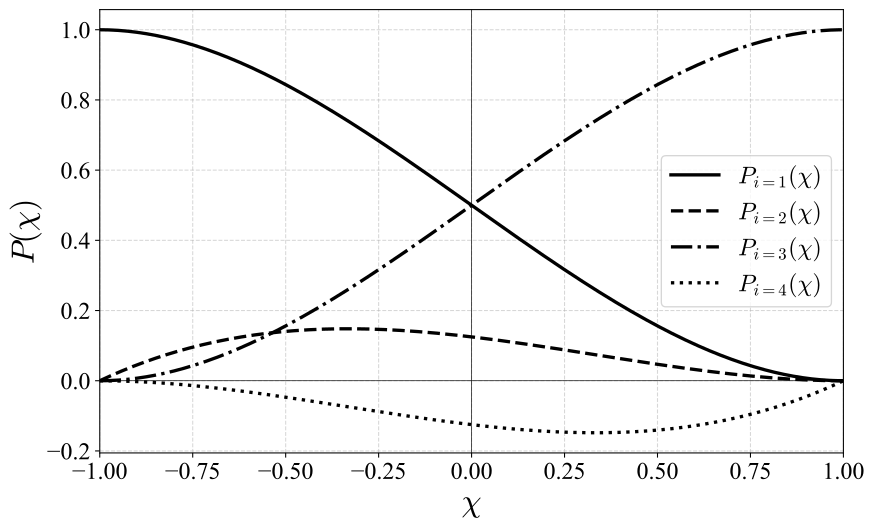
However, when a general set of boundary conditions is needed, or whenever a skewed buckling mode is possible, a more robust approximation for the displacement field is required. Castro and Donadon Castro & Donadon, 2017 present Rodrigues’ form of Legendre hierarchic orthogonal polynomials Peano, 1976De-Chao, 1986, largely applied by Bardell et al. on the vibration problems Bardell, 1991Bardell et al., 1997Bardell et al., 1997. In this form the first four terms i=1,2,3,4i = 1,2,3,4 consist of Hermite cubic polynomials:

P1(χ)=(1234χ+14χ3)δt1P2(χ)=(1818χ18χ2+18χ3)δr1P3(χ)=(12+34χ14χ3)δt2P4(χ)=(1818χ+18χ2+18χ3)δr2\begin{aligned} P_1(\chi) &= \left( \frac{1}{2} - \frac{3}{4}\chi + \frac{1}{4}\chi^3 \right) \delta_{t1} \\ P_2(\chi) &= \left( \frac{1}{8} - \frac{1}{8}\chi - \frac{1}{8}\chi^2 + \frac{1}{8}\chi^3 \right) \delta_{r1} \\ P_3(\chi) &= \left( \frac{1}{2} + \frac{3}{4}\chi - \frac{1}{4}\chi^3 \right) \delta_{t2} \\ P_4(\chi) &= \left( -\frac{1}{8} - \frac{1}{8}\chi + \frac{1}{8}\chi^2 + \frac{1}{8}\chi^3 \right) \delta_{r2} \end{aligned}

with χ{ξ,η,ζ}\chi \in \{\xi, \eta, \zeta\}, and for any i>4i > 4:

Pi(χ)=p=0i/2(1)p(2i2p7)!!2pp!(i2p1)!χi2p1P_i(\chi) = \sum_{p=0}^{i/2} \frac{(-1)^p (2i - 2p - 7)!!}{2^p p! (i - 2p - 1)!} \chi^{i-2p-1} \nonumber

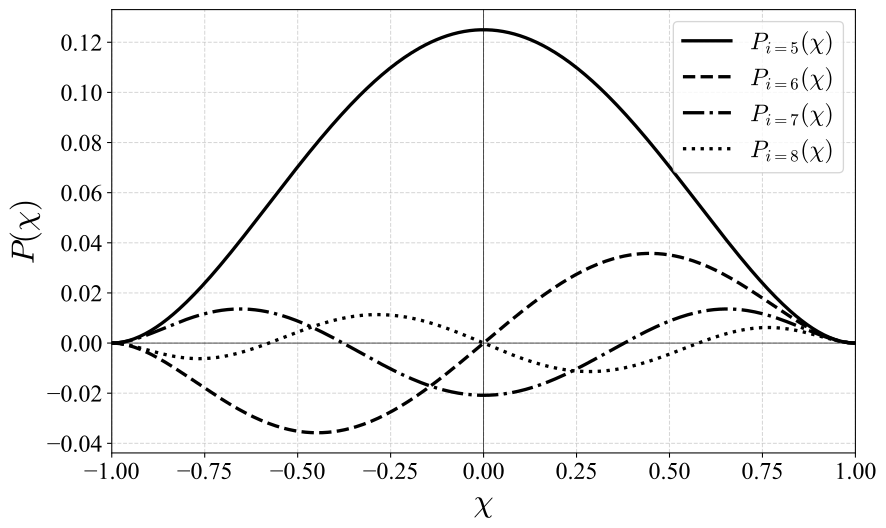
where q!!=q(q2)(2 or 1)q!! = q(q - 2) \dots (2 \text{ or } 1) such that 0!!=10!! = 1, and (i/2)(i/2) in the summation is an integer division. The binary flags δt1\delta_{t1}, δr1\delta_{r1}, δt2\delta_{t2} and δr2\delta_{r2} are equal to 0 or 1, and used in the first four terms of Rodrigues polynomials to enable or disable the translation and rotation of each domain boundary, as illustrated in Figure 2. From the fifth term onwards, the translation and rotation at the boundaries are always zero, such that they are use to increase the interpolation order in the inner part of the domain, as illustrated in Figure 3. Flag δt1\delta_{t1} is used to control the translation at boundary (χ=1\chi = -1), which is possible because using Rodrigues polynomials this is the only term among all terms in the approximation function that produces Pi(χ=1)=1P_i(\chi = -1) = 1. Similarly, δt2\delta_{t2} is used to control the translation at boundary 2 (χ=+1\chi = +1). The rotation at χ=1\chi = -1 and χ=+1\chi = +1 is respectively controlled using δr1\delta_{r1} and δr2\delta_{r2}, since they are the only terms that produce a non-null rotation P/χ\partial P / \partial \chi at each respective domain boundary. The use of rotation is specially important in FSDT or TSDT formulations. Vescovini et al. Vescovini et al., 2018 investigated the sparsity of the systems produced by different shape functions, positively supporting the use of these Legendre hierarchical polynomials.

Legendre polynomial boundary functions.

Figure 2:Legendre polynomial boundary functions.

Legendre polynomial inner functions.

Figure 3:Legendre polynomial inner functions.

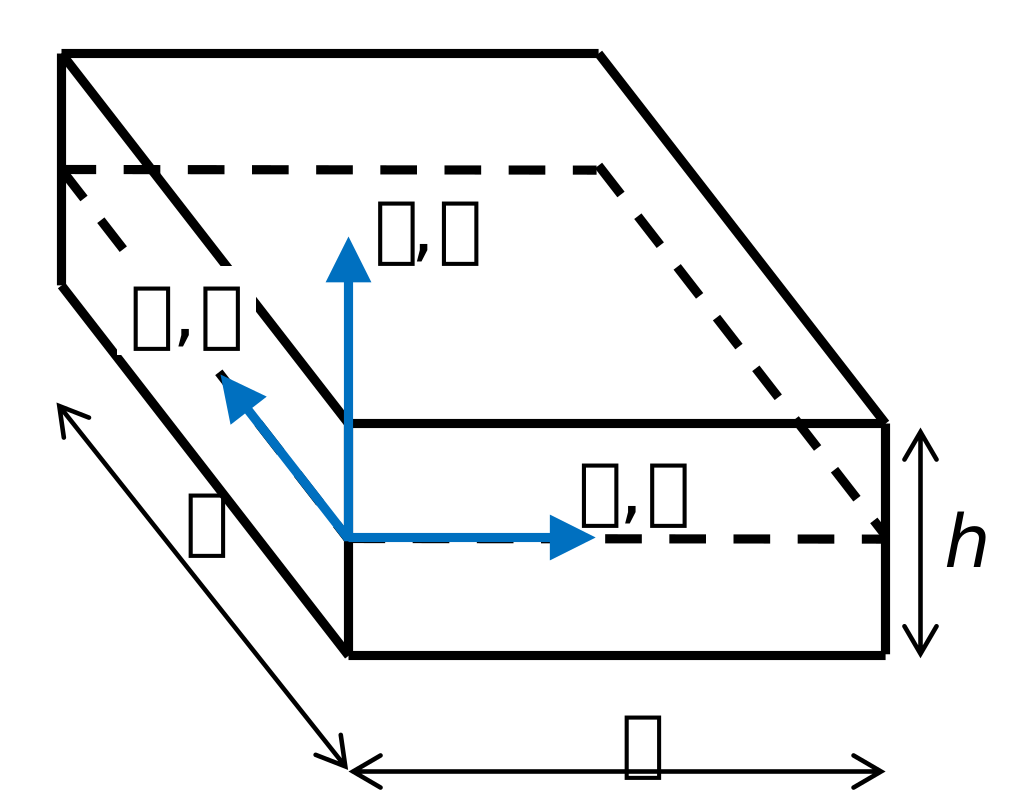
Take the plate-like domain shown in Figure 4. A general expression for the 3D displacement field is:

u={u(x,y,z)v(x,y,z)w(x,y,z)}=S(x,y,z)cˉ={Su(x,y,z)Sv(x,y,z)Sw(x,y,z)}cˉ\boldsymbol{u} = \begin{Bmatrix} u(x,y,z) \\ v(x,y,z) \\ w(x,y,z) \end{Bmatrix} = \boldsymbol{S}(x,y,z)\bar{\boldsymbol{c}} = \begin{Bmatrix} \boldsymbol{S}^u(x,y,z) \\ \boldsymbol{S}^v(x,y,z) \\ \boldsymbol{S}^w(x,y,z) \end{Bmatrix} \bar{\boldsymbol{c}} \nonumber

using Legendre polynomials and a summation convention for repeated indices:

u(x,y,z)=cijkuPi(ξ)Pj(η)Pk(ζ)u(x,y,z) = c_{ijk}^u P_i(\xi) P_j(\eta) P_k(\zeta) \nonumber
v(x,y,z)=cijkvPi(ξ)Pj(η)Pk(ζ)v(x,y,z) = c_{ijk}^v P_i(\xi) P_j(\eta) P_k(\zeta) \nonumber
w(x,y,z)=cijkwPi(ξ)Pj(η)Pk(ζ)w(x,y,z) = c_{ijk}^w P_i(\xi) P_j(\eta) P_k(\zeta) \nonumber

with 1[i,j,k]n[x,y,z]1 \le [i,j,k] \le n_{[x,y,z]} where n[x,y,z]n_[x,y,z] represents the number of terms in each global coordinate direction. The natural coordinates ξ\xi, η\eta and ζ\zeta are defined as follows for a plate:

ξ=2xa1\xi = \frac{2x}{a} - 1 \nonumber
η=2yb1\eta = \frac{2y}{b} - 1 \nonumber
ζ=2zh1\zeta = \frac{2z}{h} - 1 \nonumber
Three-dimensional plate domain.

Figure 4:Three-dimensional plate domain.

For the sake of completeness, let’s also write the expressions for the displacement field using explicit summation:

u(x,y,z)=i=1nxij=1nyk=1nzcijkuPi(ξ)Pj(η)Pk(ζ)u(x,y,z) = \sum_{i=1}^{n_x} \sum_{ij=1}^{n_y} \sum_{k=1}^{n_z} c_{ijk}^u P_i(\xi) P_j(\eta) P_k(\zeta) \nonumber
v(x,y,z)=i=1nxij=1nyk=1nzcijkvPi(ξ)Pj(η)Pk(ζ)v(x,y,z) = \sum_{i=1}^{n_x} \sum_{ij=1}^{n_y} \sum_{k=1}^{n_z} c_{ijk}^v P_i(\xi) P_j(\eta) P_k(\zeta) \nonumber
w(x,y,z)=i=1nxij=1nyk=1nzcijkwPi(ξ)Pj(η)Pk(ζ)w(x,y,z) = \sum_{i=1}^{n_x} \sum_{ij=1}^{n_y} \sum_{k=1}^{n_z} c_{ijk}^w P_i(\xi) P_j(\eta) P_k(\zeta) \nonumber

and using vector notation:

u(x,y,z)=Sucu(x,y,z) = \boldsymbol{S}^u \boldsymbol{c} \nonumber
v(x,y,z)=Sucv(x,y,z) = \boldsymbol{S}^u \boldsymbol{c} \nonumber
w(x,y,z)=Sucw(x,y,z) = \boldsymbol{S}^u \boldsymbol{c} \nonumber

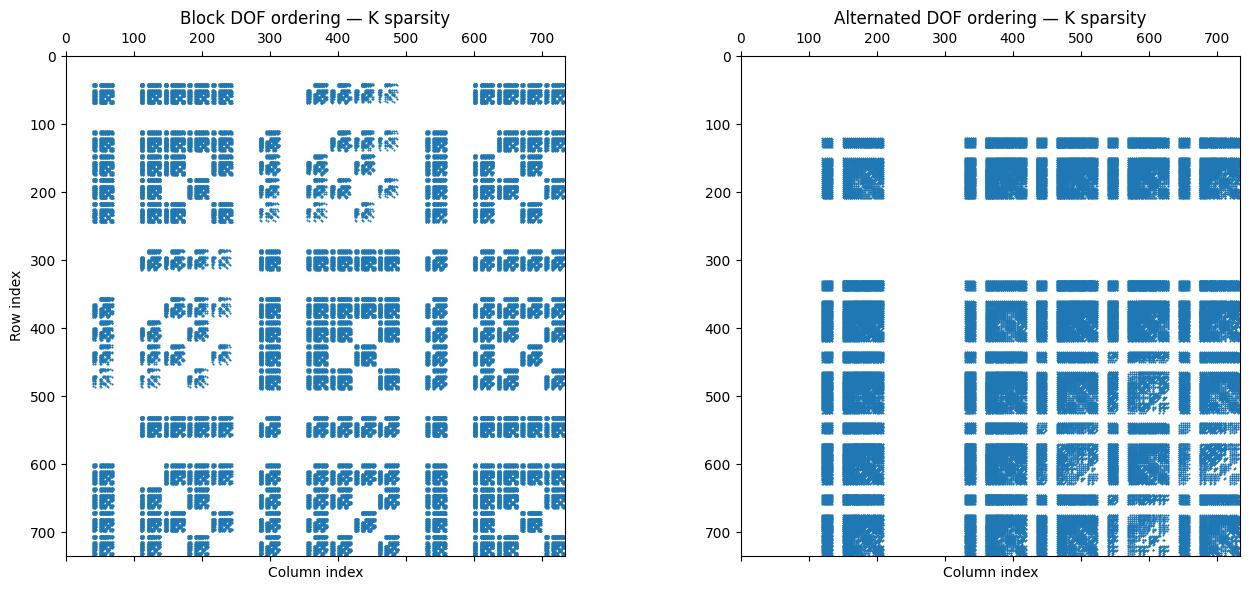
where c\boldsymbol{c} contains all coefficients cijkc_{ijk} for 1[i,j,k]n[x,y,z]1 \le [i,j,k] \le n_{[x,y,z]}. The sequence in which the coefficients are placed is arbritrary and does not affect the level of sparsity of the stiffness matrix or other structural matrices, but it does affect the bandwidth of these matrices, which significantly affects the overall efficiency and numerically stability of the implementation. To illustrate the differences in defree-of-freedom (DOF) ordering, a practical example of the buckling of a plate using 3D elasticity is investigated in depth in this notebook. There, the DOF are stored in a block- and alternated-based approach. The results are compared in detail, and the sparsity of the stiffness matrix K~\boldsymbol{K} is illustrated in Figure 5. A detailed formulation of this problem is provided in details in Section 2.

Degrees-of-freedom of the stiffness matrix for block and alternated approaches.

Figure 5:Degrees-of-freedom of the stiffness matrix for block and alternated approaches.

3Neutral Equilibrium Criterion

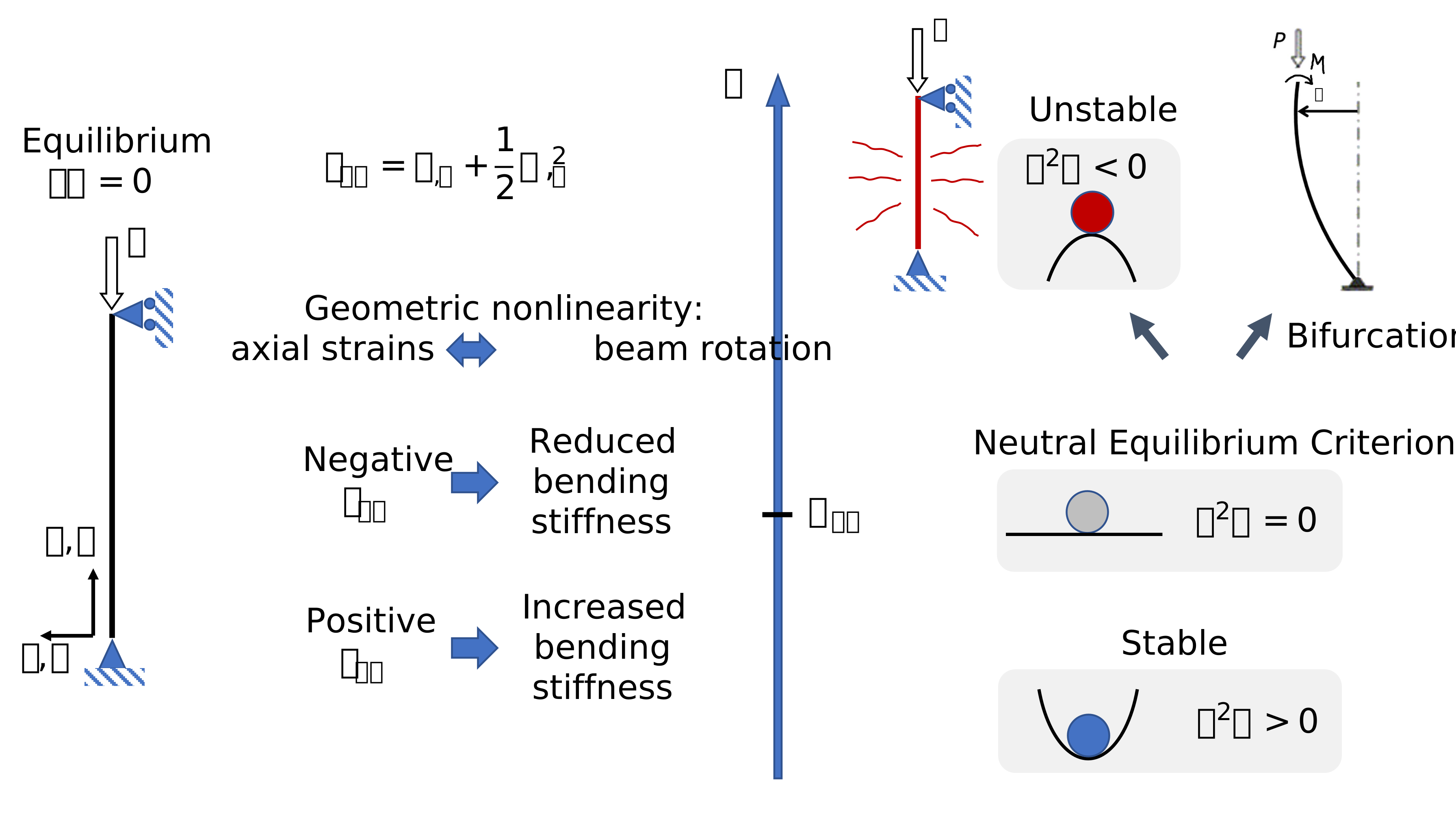
The neutral equilibrium of a vertical slender beam is illustrated in Figure 6

Neutral Equilibrium of a vertical slender beam.

Figure 6:Neutral Equilibrium of a vertical slender beam.

Given the expression for VV':

Vδuˉ=ΩσδεdΩΩ(b^δu)dΩδΩ(σ^δu)d(δΩ){V'}^\top \delta \boldsymbol{\bar{u}} = \int_{\Omega} \boldsymbol{\sigma}^\top \delta \boldsymbol{\varepsilon} \, d\Omega - \int_{\Omega} (\boldsymbol{\hat{b}}^\top \delta \boldsymbol{u}) d\Omega - \int_{\delta \Omega} (\boldsymbol{\hat{\sigma}}^\top \delta \boldsymbol{u}) d(\delta \Omega) \nonumber

The second variation of VV becomes:

δ2V=Vδuˉδuˉ=\delta^2 V = V'' \delta \boldsymbol{\bar{u}} \delta \boldsymbol{\bar{u}} = \nonumber
=ΩδσδεdΩ+Ωσδ2εdΩΩ(δb^δu)dΩΩ(b^δ2u)dΩδΩ(δσ^δu)d(δΩ)δΩ(σ^δ2u)d(δΩ)= \int_{\Omega} \delta \boldsymbol{\sigma}^\top \delta \boldsymbol{\varepsilon} \, d\Omega + \int_{\Omega} \boldsymbol{\sigma}^\top \delta^2 \boldsymbol{\varepsilon} \, d\Omega - \int_{\Omega} (\delta \boldsymbol{\hat{b}}^\top \delta \boldsymbol{u}) d\Omega - \int_{\Omega} (\boldsymbol{\hat{b}}^\top \delta^2 \boldsymbol{u}) d\Omega - \int_{\delta \Omega} (\delta \boldsymbol{\hat{\sigma}}^\top \delta \boldsymbol{u}) d(\delta \Omega) - \int_{\delta \Omega} (\boldsymbol{\hat{\sigma}}^\top \delta^2 \boldsymbol{u}) d(\delta \Omega) \nonumber

In a system without follower forces δσ^=δb^=0\delta \boldsymbol{\hat{\sigma}} = \delta \boldsymbol{\hat{b}} = \boldsymbol{0}, and we can consider δ2uδu\delta^2 \boldsymbol{u} \ll \delta \boldsymbol{u}:

Vδuˉδuˉ=ΩδσδεdΩ+Ωσδ2εdΩV'' \delta \boldsymbol{\bar{u}} \delta \boldsymbol{\bar{u}} = \int_{\Omega} \delta \boldsymbol{\sigma}^\top \delta \boldsymbol{\varepsilon} \, d\Omega + \int_{\Omega} \boldsymbol{\sigma}^\top \delta^2 \boldsymbol{\varepsilon} \, d\Omega \nonumber

The first integral represents the nonlinear constitutive stiffness, whereas the second integral represents the geometric stiffness matrix. If the strains can be represented as:

ε=(BL+12BNL)uˉandδε=(BL+BNL)δuˉ\boldsymbol{\varepsilon} = \left( \boldsymbol{B}_L + \frac{1}{2}\boldsymbol{B}_{NL} \right) \boldsymbol{\bar{u}} \qquad \text{and} \qquad \delta \boldsymbol{\varepsilon} = (\boldsymbol{B}_L + \boldsymbol{B}_{NL}) \delta \boldsymbol{\bar{u}} \nonumber

And the stresses as:

σ=Cε\boldsymbol{\sigma} = \boldsymbol{C}\boldsymbol{\varepsilon} \nonumber

Then:

Vδuˉδuˉ=δuˉΩ(BL+BNL)C(BL+BNL)dΩδuˉ+Ωσδ2εdΩV'' \delta \boldsymbol{\bar{u}} \delta \boldsymbol{\bar{u}} = \delta \boldsymbol{\bar{u}}^\top \int_{\Omega} (\boldsymbol{B}_L + \boldsymbol{B}_{NL})^\top \boldsymbol{C} (\boldsymbol{B}_L + \boldsymbol{B}_{NL}) d\Omega \, \delta \boldsymbol{\bar{u}} + \int_{\Omega} \boldsymbol{\sigma}^\top \delta^2 \boldsymbol{\varepsilon} \, d\Omega \nonumber

The neutral equilibrium criterion states that:

δ2V=0\delta^2 V = 0 \nonumber
δ2V=Vδuˉδuˉ=δuˉΩ(BL+BNL)C(BL+BNL)dΩδuˉ+δuˉKGδuˉ=0\delta^2 V = V'' \delta \boldsymbol{\bar{u}} \delta \boldsymbol{\bar{u}} = \delta \boldsymbol{\bar{u}}^\top \int_{\Omega} (\boldsymbol{B}_L + \boldsymbol{B}_{NL})^\top \boldsymbol{C} (\boldsymbol{B}_L + \boldsymbol{B}_{NL}) d\Omega \, \delta \boldsymbol{\bar{u}} + \delta \boldsymbol{\bar{u}}^\top \boldsymbol{K}_G \delta \boldsymbol{\bar{u}} = 0 \nonumber

This term represents the constitutive stiffness matrix:

KC=Ω(BL+BNL)C(BL+BNL)dΩ\boldsymbol{K}_C = \int_{\Omega} (\boldsymbol{B}_L + \boldsymbol{B}_{NL})^\top \boldsymbol{C} (\boldsymbol{B}_L + \boldsymbol{B}_{NL}) d\Omega \nonumber

From a linear fundamental (pre-buckling) state we have that BNL=0\boldsymbol{B}_{NL} = \boldsymbol{0}:

KC=K0=ΩBLCBLdΩ\boldsymbol{K}_C = \boldsymbol{K}_0 = \int_{\Omega} \boldsymbol{B}_L^\top \boldsymbol{C} \boldsymbol{B}_L d\Omega \nonumber

such that:

δ2V=δuˉK0δuˉ+δuˉKGδuˉ=0\delta^2 V = \delta \boldsymbol{\bar{u}}^\top \boldsymbol{K}_0 \delta \boldsymbol{\bar{u}} + \delta \boldsymbol{\bar{u}}^\top \boldsymbol{K}_G \delta \boldsymbol{\bar{u}} = 0 \nonumber

where KG\boldsymbol{K}_G represents the geometric stiffness matrix. Note that this expression must be true for any variation δuˉ\delta \boldsymbol{\bar{u}}, such that K0+λKG\boldsymbol{K}_0 + \lambda\boldsymbol{K}_G must be singular for the expression to be generaly true, hence:

det(K0+λKG)=0\det(\boldsymbol{K}_0 + \lambda\boldsymbol{K}_G) = 0 \nonumber

where λ\lambda is a load multiplier applied to the initial stress state defining KG\boldsymbol{K}_G. This is the well-known eigenvalue problem for buckling, also referred to as linear buckling equation.

References
  1. Voigt, W. (1910). Lehrbuch der Kristallphysik (mit Ausschluss der Kristalloptik). Teubner.
  2. Castro, S. G. P., Mittelstedt, C., Monteiro, F. A. C., Arbelo, M. A., Ziegmann, G., & Degenhardt, R. (2014). Linear buckling predictions of unstiffened laminated composite cylinders and cones under various loading and boundary conditions using semi-analytical models. Composite Structures, 118, 303–315. 10.1016/j.compstruct.2014.07.037
  3. Castro, S. G. P., Mittelstedt, C., Monteiro, F. A. C., Degenhardt, R., & Ziegmann, G. (2015). Evaluation of non-linear buckling loads of geometrically imperfect composite cylinders and cones with the Ritz method. Composite Structures, 122, 284–299. 10.1016/j.compstruct.2014.11.050
  4. Castro, S. G. P., Mittelstedt, C., Monteiro, F. A. C., Arbelo, M. A., Degenhardt, R., & Ziegmann, G. (2015). A semi-analytical approach for linear and non-linear analysis of unstiffened laminated composite cylinders and cones under axial, torsion and pressure loads. Thin-Walled Structures, 90, 61–73. 10.1016/j.tws.2015.01.002
  5. Castro, S. G. P., & Donadon, M. V. (2017). Assembly of semi-analytical models to address linear buckling and vibration of stiffened composite panels with debonding defect. Composite Structures, 160, 232–247. 10.1016/j.compstruct.2016.10.026
  6. Peano, A. (1976). Hierarchies of conforming finite elements for plane elasticity and plate bending. Computers & Mathematics with Applications, 2(3–4), 211–224. 10.1016/0898-1221(76)90014-6
  7. De-Chao, Z. (1986). Development of Hierarchal Finite Element Methods at BIAA. In Computational Mechanics ’86 (pp. 159–164). Springer Japan. 10.1007/978-4-431-68042-0_17
  8. Bardell, N. S. (1991). Free vibration analysis of a flat plate using the hierarchical finite element method. Journal of Sound and Vibration, 151(2), 263–289. 10.1016/0022-460x(91)90855-e
  9. Bardell, N. S., Dunsdon, J. M., & Langley, R. S. (1997). On the free vibration of completely free, open, cylindrically curved, isotropic shell panels. Journal of Sound and Vibration, 207(5), 647–669. 10.1006/jsvi.1997.1115
  10. Bardell, N. S., Dunsdon, J. M., & Langley, R. S. (1997). Free and forced vibration analysis of thin, laminated, cylindrically curved panels. Composite Structures, 38(1–4), 453–462. 10.1016/s0263-8223(97)00080-9
  11. Vescovini, R., Dozio, L., D’Ottavio, M., & Polit, O. (2018). On the application of the Ritz method to free vibration and buckling analysis of highly anisotropic plates. Composite Structures, 192, 460–474. 10.1016/j.compstruct.2018.03.017