Mode I benchmark: Leciñana et al. (2023), AS4D/PEKK-FC fatigue specimens#
Leciñana, J. Renart, A. Turon, J. Zurbitu and B. H. A. H. Tijs, Characterization and analysis of the mode I interlaminar fatigue behaviour of thermoplastic composites considering R-curve effects, Engineering Fracture Mechanics 286 (2023) 109273, https://doi.org/10.1016/j.engfracmech.2023.109273.
The paper studies mode I fatigue of AS4D/PEKK-FC DCB specimens (30 plies of 0.138 mm, width 25 mm, length 225 mm, side-clamped loading blocks) with a fatigue cohesive zone model (CF20, ABAQUS UMAT, CPE4 + COH2D4, 0.1 mm elements) and a static cohesive law obtained by superposing five bilinear laws (Table 2). Fatigue is outside the scope of panels, and no quasi-static load-displacement curve is given. The paper provides, however, the initial compliance \(C = \delta/F\) of five mode I
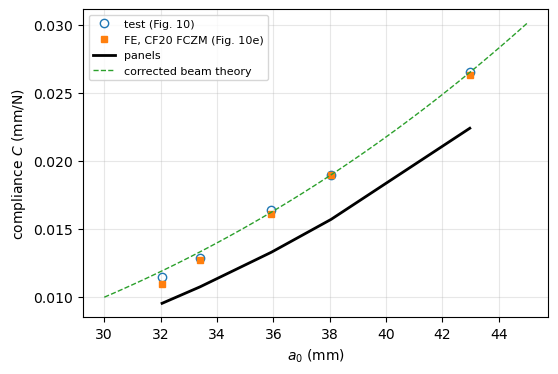
specimens with known initial crack lengths (Table 3 and Fig. 10), measured in the first cycles before any damage, which is a linear elastic mode I result that panels can predict.
Table 1: \(E_{11}\) = 138.3 GPa, \(E_{22}\) = 10.4 GPa (tensile moduli), \(G_{12} = G_{13}\) = 5.19 GPa; \(\nu_{12}\) = 0.316 is taken from Tijs et al. (2022);
Table 3: initial crack lengths 32.05, 33.4, 35.93, 38.05 and 42.97 mm (severities 0.43, 0.38, 0.30, 0.24 and 0.14);
Fig. 10: the experimental compliance and the numerical one of the three fatigue damage accumulation architectures at the first cycles.
Digitised data. The compliances at the first cycles were read from Fig. 10 by eye, with an estimated uncertainty of \(\pm 0.0003\) mm/N.
[1]:
%matplotlib inline
import os
import sys

import numpy as np
import matplotlib.pyplot as plt
from IPython.display import Markdown, display

sys.path.insert(0, os.path.abspath('.'))
import dcb_utils as du

# True runs panels and saves the results in RESULTS, False loads them
RERUN = True
RESULTS = 'results'
# comma-separated keys, runs only these cases (used to run cases in parallel)
ONLY = os.environ.get('DCB_CASES')
ONLY = ONLY.split(',') if ONLY else None
Specimens and compliance data#
[2]:
spec = dict(E1=138300., E2=10400., nu12=0.316, G12=5190., h=15*0.138, b=25., G1c=1.12)

exp_tests = {
    'initial_compliance': dict(source='Table 3 and Fig. 10 (experimental onset data, first cycles)',
        a0=np.array([32.05, 33.4, 35.93, 38.05, 42.97]),
        C=np.array([0.0115, 0.0129, 0.0164, 0.0190, 0.0265])),
}
fe_cases = {
    'CF20_FCZM': dict(source='Fig. 10e, numerical onset, superposition architecture 3, first cycles',
        model='ABAQUS/Standard, CPE4 + COH2D4 with the CF20 fatigue UMAT, 0.1 mm elements, 5 superposed bilinear laws',
        a0=np.array([32.05, 33.4, 35.93, 38.05, 42.97]),
        C=np.array([0.0110, 0.0127, 0.0161, 0.0190, 0.0263])),
}
panels model#
Linear elastic analysis of the DCB with dcb_utils.elastic_compliance: same model as in the other notebooks, with an opening of 0.05 mm, well below the damage onset. The specimen length is taken as \(a_0 + 100\) mm; the compliance does not depend on it for this length. The reference is the corrected beam theory, \(C = 2 (a + \chi h)^3/(3 E I)\) with \(E I = D_{11} b\).
[3]:
a0 = exp_tests['initial_compliance']['a0']
# linear analysis: m_tsl = 15 is 0.90 lambda L_tsl, enough for the compliance,
# below the rules of the nonlinear runs (dcb_utils.discretize)
C_panels = np.array([du.elastic_compliance(dict(spec, L=a + 100., a0=a, k_o=1.e5, tau_o=87.,
                                                L_tsl=20., m_tsl=15, nx=60), a)
                     for a in a0])
C_cbt = du.compliance_cbt(dict(spec, L=100., a0=40.), a0)
C_exp = exp_tests['initial_compliance']['C']
C_fe = fe_cases['CF20_FCZM']['C']
lines = ['| $a_0$ (mm) | test (mm/N) | FE (mm/N) | panels (mm/N) | CBT (mm/N) | panels vs test | panels vs FE | panels vs CBT |', '|---|---|---|---|---|---|---|---|']
for a, ce, cf, cp, cb in zip(a0, C_exp, C_fe, C_panels, C_cbt):
    lines.append(f'| {a:.2f} | {ce:.4f} | {cf:.4f} | {cp:.4f} | {cb:.4f} | {100*(cp/ce - 1):+.1f}% | {100*(cp/cf - 1):+.1f}% | {100*(cp/cb - 1):+.1f}% |')
display(Markdown('\n'.join(lines)))
fig, ax = plt.subplots(figsize=(6, 4))
aa = np.linspace(30, 45, 50)
ax.plot(a0, C_exp, 'o', mfc='none', label='test (Fig. 10)')
ax.plot(a0, C_fe, 's', ms=4, label='FE, CF20 FCZM (Fig. 10e)')
ax.plot(a0, C_panels, 'k-', lw=2, label='panels')
ax.plot(aa, du.compliance_cbt(dict(spec, L=100., a0=40.), aa), '--', lw=1, label='corrected beam theory')
ax.set_xlabel('$a_0$ (mm)')
ax.set_ylabel('compliance $C$ (mm/N)')
ax.grid(True, alpha=0.3)
ax.legend(fontsize=8)
plt.show()
\(a_0\) (mm) |
test (mm/N) |
FE (mm/N) |
panels (mm/N) |
CBT (mm/N) |
panels vs test |
panels vs FE |
panels vs CBT |
|---|---|---|---|---|---|---|---|
32.05 |
0.0115 |
0.0110 |
0.0096 |
0.0119 |
-16.9% |
-13.2% |
-20.0% |
33.40 |
0.0129 |
0.0127 |
0.0108 |
0.0133 |
-16.6% |
-15.3% |
-19.3% |
35.93 |
0.0164 |
0.0161 |
0.0133 |
0.0162 |
-18.9% |
-17.4% |
-18.1% |
38.05 |
0.0190 |
0.0190 |
0.0157 |
0.0190 |
-17.3% |
-17.3% |
-17.2% |
42.97 |
0.0265 |
0.0263 |
0.0224 |
0.0265 |
-15.5% |
-14.8% |
-15.5% |
Discussion#
Compliance. panels predicts compliances 15.5-18.9% below the measured ones and 13-17% below the FE of the paper, while the corrected beam theory matches the tests within 4%. The difference is the flexibility that the CLPT arms of
panelsdo not have: transverse shear deformation, which is large for AS4D/PEKK-FC (\(E_{11}/G_{13}\) = 27), and the rotation at the crack front, which inpanelscomes only from the elastic foundation of the cohesive interface. The corrected beam theory accounts for both through \(\chi h\) = 3.7 mm, i.e. an effective crack length 9-12% longer, which corresponds to a compliance 28-39% higher than simple beam theory;panelsrecovers part of it through the foundation.Consequence for the fracture analyses. In the load-opening curves of the other notebooks, the same effect appears as an initial stiffness 9-17% higher than the corrected beam theory, while the peak loads, controlled by the energy release rate, stay within a few percent of it.
Fatigue. The fatigue onset and propagation of the paper are outside the scope of
panels.