Speed of the cohesive coupons: the defaults against a reference checkout and the options for speed#
The coupons of `delamination.create_coupon <../cohesive_zone_mixed_mode.rst>`__ assemble and factorize the tangent stiffness matrix at every Newton-Raphson iteration. Two changes, on by default, make the assembly faster than in the reference checkout without them, described at the end of this cell, and change the results at round-off level only:
the kernels keep the tables of the approximation functions at the integration points on the shell from one call to the next, see Approximation functions tabulated at the integration points;
Bardell’s functions are evaluated by Horner’s rule instead of with
pow(), see Bardell’s hierarchical functions.
Three options, all off by default, reduce the time further without changing the results beyond the round-off (see Options for speed and Plate kernels as matrix products):
plate_kernels='blas'of`MultiDomain<../multidomain.rst>`__ andcreate_coupon: the plate matrices and vectors ofplate_clpt_donnellandplate_fsdt_donnellas products of dense matrices with operators tabulated once per domain,`panels.multidomain.plate_blas<../plate_blas.rst>`__;reuse_kT=Trueofsolve_couponandMultiDomain.get_reduced_functions: the load vector of the prescribed displacement from the tangent already assembled at the same configuration;linear_solver='pardiso_lu'(oneMKL) or'dense_lu'ofstructsolve>=0.13.0, forwarded bysolve_coupontostructsolve.Analysis, see the linear solvers of structsolve.
This notebook
compares the defaults with panels 0.17.0, for one domain of the size of the cohesive domains of a long coupon: matrices, vectors and time of the first and of the later calls;
compares, for one domain, the matrices and vectors of the Cython kernels and of
plate_kernels='blas', and the time of both;runs a DCB coupon with 0.17.0, with the defaults and with the options on, and compares the increments, the Newton-Raphson iterations, the load-displacement curves and the run times.
panels 0.17.0 runs in a separate Python process, from the checkout given by the environment variable PANELS_0170_PATH (a checkout of the commit 25d1ecb, built on the same machine, for the stored outputs); the current version runs in the same way from its own checkout. Without PANELS_0170_PATH the comparisons with 0.17.0 are skipped. The helpers are in coupon_speed_utils.py, next to this notebook. The times are those of the machine that ran the notebook, printed below; they depend on
its CPU and BLAS library, the equality of the results does not.
[1]:
%matplotlib inline
import json
import os
import platform
import subprocess
import sys
import tempfile
import time

import numpy as np
import matplotlib.pyplot as plt
from IPython.display import Markdown, display

import structsolve
import panels
from coupon_speed_utils import one_domain, tangent_and_fint, dcb


def table(headers, rows):
    lines = ['| ' + ' | '.join(headers) + ' |', '|' + '---|'*len(headers)]
    lines += ['| ' + ' | '.join(str(v) for v in row) + ' |' for row in rows]
    display(Markdown('\n'.join(lines)))


def rel(A, B):
    A = A.toarray() if hasattr(A, 'toarray') else np.asarray(A)
    B = B.toarray() if hasattr(B, 'toarray') else np.asarray(B)
    return np.abs(A - B).max()/np.abs(B).max()


def median_time(func, repeat=5):
    func()  # warm-up, also builds the operators of 'blas'
    times = []
    for _ in range(repeat):
        t0 = time.perf_counter()
        func()
        times.append(time.perf_counter() - t0)
    return float(np.median(times))


def linear_solver():
    '''pardiso_lu with oneMKL, else dense_lu, when structsolve has them'''
    try:
        from structsolve.static import LINEAR_SOLVERS
    except ImportError:
        return None
    if 'pardiso_lu' in LINEAR_SOLVERS:
        try:
            from structsolve.pardiso import load_mkl
            load_mkl()
            return 'pardiso_lu'
        except Exception:
            pass
    return 'dense_lu' if 'dense_lu' in LINEAR_SOLVERS else None


def commit(path):
    try:
        return subprocess.run(['git', '-C', path, 'rev-parse', '--short', 'HEAD'], capture_output=True,
                              text=True, check=True).stdout.strip()
    except Exception:
        return 'unknown'


PANELS_NOW = os.path.dirname(os.path.dirname(os.path.abspath(panels.__file__)))
PANELS_0170 = os.environ.get('PANELS_0170_PATH')


def run_with(path, *args):
    '''coupon_speed_utils.py in a new Python process with the panels of ``path``; the JSON it prints'''
    env = dict(os.environ, PYTHONPATH=path)
    out = subprocess.run([sys.executable, 'coupon_speed_utils.py', *args], env=env, capture_output=True,
                         text=True, check=True)
    return json.loads(out.stdout.strip().splitlines()[-1])


from structsolve.static import LINEAR_SOLVERS
print('panels: this version, on commit', commit(PANELS_NOW), '| structsolve linear solvers',
      LINEAR_SOLVERS, '| numpy', np.__version__)
print('panels 0.17.0:', 'commit %s' % commit(PANELS_0170) if PANELS_0170 else 'not given, comparisons skipped')
print(platform.processor(), '|', os.cpu_count(), 'logical CPUs')
SOLVER = linear_solver()
print('linear solver of the options:', SOLVER)
panels: this version, on commit 55a887a | structsolve linear solvers ('splu', 'pardiso', 'pardiso_lu', 'dense_lu') | numpy 2.4.4
panels 0.17.0: commit 25d1ecb
AMD64 Family 25 Model 117 Stepping 2, AuthenticAMD | 16 logical CPUs
linear solver of the options: pardiso_lu
1. The defaults against panels 0.17.0#
One domain of \(20 \times 25.4\) mm, \([0]_{12}\) AS4/PEEK, with \(m = 24\), \(n = 4\) terms and \(240 \times 6\) Gauss-Legendre points, as the long cohesive domains of a coupon, at a random configuration: the tangent (\(K_C\) and \(K_G\) with NLgeom=True) and the internal force vector, assembled with MultiDomain([p], conn=[]) and the default Cython kernels, by this version and by 0.17.0, each in its own process. The time of the first call on a new domain
includes filling the tables; the later calls on the same domain only read them, whereas 0.17.0 filled them at every call.
[2]:
rows = []
if PANELS_0170:
    tmp = tempfile.mkdtemp()
    for model in ('plate_clpt_donnell', 'plate_fsdt_donnell'):
        res = {}
        for name, path in (('now', PANELS_NOW), ('0.17.0', PANELS_0170)):
            out = os.path.join(tmp, '%s_%s.npz' % (model, name.replace('.', '')))
            times = run_with(path, 'domain', model, out, '9')
            with np.load(out) as data:
                res[name] = (times, [data['arr_%d' % i] for i in range(3)])
        (t_now, a_now), (t_old, a_old) = res['now'], res['0.17.0']
        rows.append(['`%s`' % model] + ['%.1e' % rel(a, b) for a, b in zip(a_now, a_old)]
                    + ['%.3f' % t_old['first'], '%.3f' % t_now['first'], '%.2f' % (t_old['first']/t_now['first']),
                       '%.3f' % t_old['later'], '%.3f' % t_now['later'], '%.2f' % (t_old['later']/t_now['later'])])
    table(['model', '$K_C$', '$K_G$', '$F_{int}$', 'first, 0.17.0 (s)', 'first (s)', 'speed-up',
           'later, 0.17.0 (s)', 'later (s)', 'speed-up'], rows)
else:
    print('PANELS_0170_PATH not set: comparison with 0.17.0 skipped')
model |
\(K_C\) |
\(K_G\) |
\(F_{int}\) |
first, 0.17.0 (s) |
first (s) |
speed-up |
later, 0.17.0 (s) |
later (s) |
speed-up |
|---|---|---|---|---|---|---|---|---|---|
|
2.0e-10 |
4.2e-10 |
1.3e-10 |
0.288 |
0.251 |
1.15 |
0.198 |
0.167 |
1.19 |
|
4.7e-12 |
9.2e-10 |
5.9e-12 |
0.350 |
0.238 |
1.47 |
0.230 |
0.167 |
1.38 |
The columns \(K_C\) to \(F_{int}\) are the largest difference from 0.17.0 over the largest entry. They are not at the level of the unit round-off, \(10^{-16}\), because the terms of high degree of Bardell’s functions lose digits by cancellation in any evaluation of their monomial form, and Horner’s rule with correctly rounded coefficients is the more accurate of the two, see Bardell’s hierarchical functions. The times are medians of 9 calls of \(K_C + K_G + F_{int}\); the later calls are those of the Newton-Raphson iterations of an analysis.
2. One domain: Cython kernels against plate_kernels='blas'#
A domain of \(20 \times 25.4\) mm, \([0]_{12}\) AS4/PEEK, \(m = 15\), \(n = 6\) terms and \(60 \times 10\) Gauss-Legendre points, as the cohesive domains of the coupons, at a random configuration: the tangent (\(K_C\) and \(K_G\) with NLgeom=True), the internal force vector and the product of the tangent by a vector, assembled with MultiDomain([p], conn=[]) and either option.
[3]:
rows = []
for model in ('plate_clpt_donnell', 'plate_fsdt_donnell'):
    mds = {k: one_domain(model, plate_kernels=k) for k in ('cython', 'blas')}
    rng = np.random.default_rng(0)
    c = 1e-2*rng.standard_normal(mds['cython'].get_size())
    v = rng.standard_normal(c.size)
    res, times = {}, {}
    for k, md_ in mds.items():
        kC, kG, fint = tangent_and_fint(md_, c)
        res[k] = dict(kC=kC, kG=kG, fint=fint, kTv=md_.calc_kTv(c, v))
        times[k] = median_time(lambda: tangent_and_fint(md_, c))
    rows.append(['`%s`' % model] + ['%.1e' % rel(res['blas'][k], res['cython'][k]) for k in res['blas']]
                + ['%.3f' % times['cython'], '%.3f' % times['blas'], '%.1f' % (times['cython']/times['blas'])])
table(['model', '$K_C$', '$K_G$', '$F_{int}$', '$K_T v$', 'Cython (s)', 'blas (s)', 'speed-up'], rows)
model |
\(K_C\) |
\(K_G\) |
\(F_{int}\) |
\(K_T v\) |
Cython (s) |
blas (s) |
speed-up |
|---|---|---|---|---|---|---|---|
|
2.7e-15 |
3.4e-15 |
2.9e-15 |
3.7e-15 |
0.087 |
0.021 |
4.2 |
|
5.1e-15 |
3.7e-15 |
3.0e-15 |
3.6e-15 |
0.097 |
0.037 |
2.6 |
The columns \(K_C\) to \(K_T v\) are the largest difference over the largest entry: the round-off. The times are those of one tangent and one internal force vector, \(K_C + K_G + F_{int}\), the median of 5 evaluations after a warm-up, i.e. with the tables of the Cython kernels already filled.
3. A DCB coupon: 0.17.0, the defaults and the options#
The DCB of AS4/PEEK, \(25.4\) mm wide, arms of \([0]_{12}\), \(0.13\) mm plies, \(a_0 = 30\) mm, \(60\) mm long, with the bilinear law of the tests of the coupons (used for verification only), CLPT, three cohesive domains of 15 terms over the first \(15\) mm of the bonded length, up to an opening \(\delta = 3\) mm, past the onset of the damage, in increments of \(0.25\) mm. The Newton-Raphson iterations of each increment are counted as the evaluations of the tangent. The run with 0.17.0 uses its defaults, in its own process.
[4]:
runs = {}
if PANELS_0170:
    r = run_with(PANELS_0170, 'dcb')
    runs['panels 0.17.0'] = {k: np.asarray(v) for k, v in r.items()}
runs['defaults'] = dcb(False)
runs["plate_kernels='blas', reuse_kT=True"] = dcb(True)
if SOLVER is not None:
    runs["plate_kernels='blas', reuse_kT=True, linear_solver='%s'" % SOLVER] = dcb(True, linear_solver=SOLVER)
ref = runs['defaults']
old = runs.get('panels 0.17.0')
rows = []
for name, r in runs.items():
    same = len(r['delta']) == len(ref['delta'])
    rows.append([name, len(r['delta']), same and np.array_equal(r['delta'], ref['delta']),
                 same and np.array_equal(r['iterations'], ref['iterations']), int(r['iterations'].sum()),
                 '%.1e' % np.abs(r['P'] - ref['P']).max() if same else '-', '%.1f' % r['time'],
                 '%.2f' % (ref['time']/r['time']),
                 '%.2f' % (old['time']/r['time']) if old is not None else '-'])
table(['run', 'increments', 'same $\\delta$', 'same iterations', 'iterations',
       'max $\\lvert \\Delta P \\rvert$ (N)', 'time (s)', 'speed-up vs defaults', 'speed-up vs 0.17.0'], rows)
print('largest damage variable at the end: %.3f' % ref['max_d'][-1])
run |
increments |
same \(\delta\) |
same iterations |
iterations |
max \(\lvert \Delta P \rvert\) (N) |
time (s) |
speed-up vs defaults |
speed-up vs 0.17.0 |
|---|---|---|---|---|---|---|---|---|
panels 0.17.0 |
12 |
True |
True |
26 |
1.9e-11 |
20.7 |
0.97 |
1.00 |
defaults |
12 |
True |
True |
26 |
0.0e+00 |
20.1 |
1.00 |
1.03 |
plate_kernels=’blas’, reuse_kT=True |
12 |
True |
True |
26 |
3.2e-11 |
13.3 |
1.51 |
1.56 |
plate_kernels=’blas’, reuse_kT=True, linear_solver=’pardiso_lu’ |
12 |
True |
True |
26 |
6.1e-11 |
9.8 |
2.05 |
2.12 |
largest damage variable at the end: 0.976
[5]:
fig, axes = plt.subplots(1, 2, figsize=(10, 3.8))
for (name, r), ls in zip(runs.items(), ('-', '--', '-.', ':')):
    axes[0].plot(r['delta'], r['P'], ls, marker='o', ms=3, lw=1, label=name)
    if r is not ref:
        axes[1].semilogy(r['delta'], np.maximum(np.abs(r['P'] - ref['P']), 1e-16), ls, marker='o', ms=3,
                         label=name)
axes[0].set_xlabel(r'$\delta$ (mm)')
axes[0].set_ylabel('$P$ (N)')
axes[0].legend(fontsize=7)
axes[1].axhline(1e-6, color='k', lw=0.8, ls='-.', label='1e-6 N')
axes[1].set_xlabel(r'$\delta$ (mm)')
axes[1].set_ylabel(r'$|P - P_{defaults}|$ (N)')
axes[1].legend(fontsize=7)
for ax in axes:
    ax.grid(alpha=0.3)
plt.tight_layout()
plt.show()
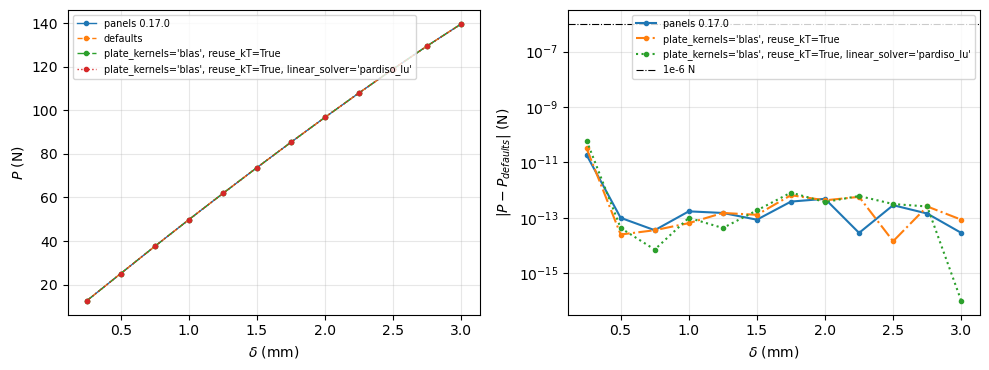
The defaults give the same increments and iterations as 0.17.0, with loads that differ by the round-off of the new evaluation of Bardell’s functions; the options give the same increments and the same iterations as the defaults, and loads that differ by the round-off, far below \(10^{-6}\) N; the curves overlap. For this DCB the defaults take only a few percent less time than 0.17.0: with 15 by 6 terms per cohesive domain the tables are a small part of the assembly, whose loops over the pairs
of terms are unchanged; the gain of the defaults is larger for long domains with many points and few terms, as in section 1. The speed-up of the options grows with the number of terms and of points of the cohesive domains, whose plate kernels dominate the time with the defaults, and the faster factorizations matter once the plate kernels are fast. tests/multidomain/test_plate_blas.py checks the same equalities of the options on a smaller DCB, and
tests/tests_shell/test_kernel_references.py the kernels of all the models against stored outputs of 0.17.0.